
In an industry where the product changes every day and time defines profitability, not having timely information is not a technological problem… it is an operational risk.
Fruthos del Trópico, a Costa Rican company specialized in the commercialization of seasonal fruits, faced a critical challenge: operating with systems that could not keep up with the pace of their business.
This is their transformation story.
The challenge: systems that did not evolve with the business
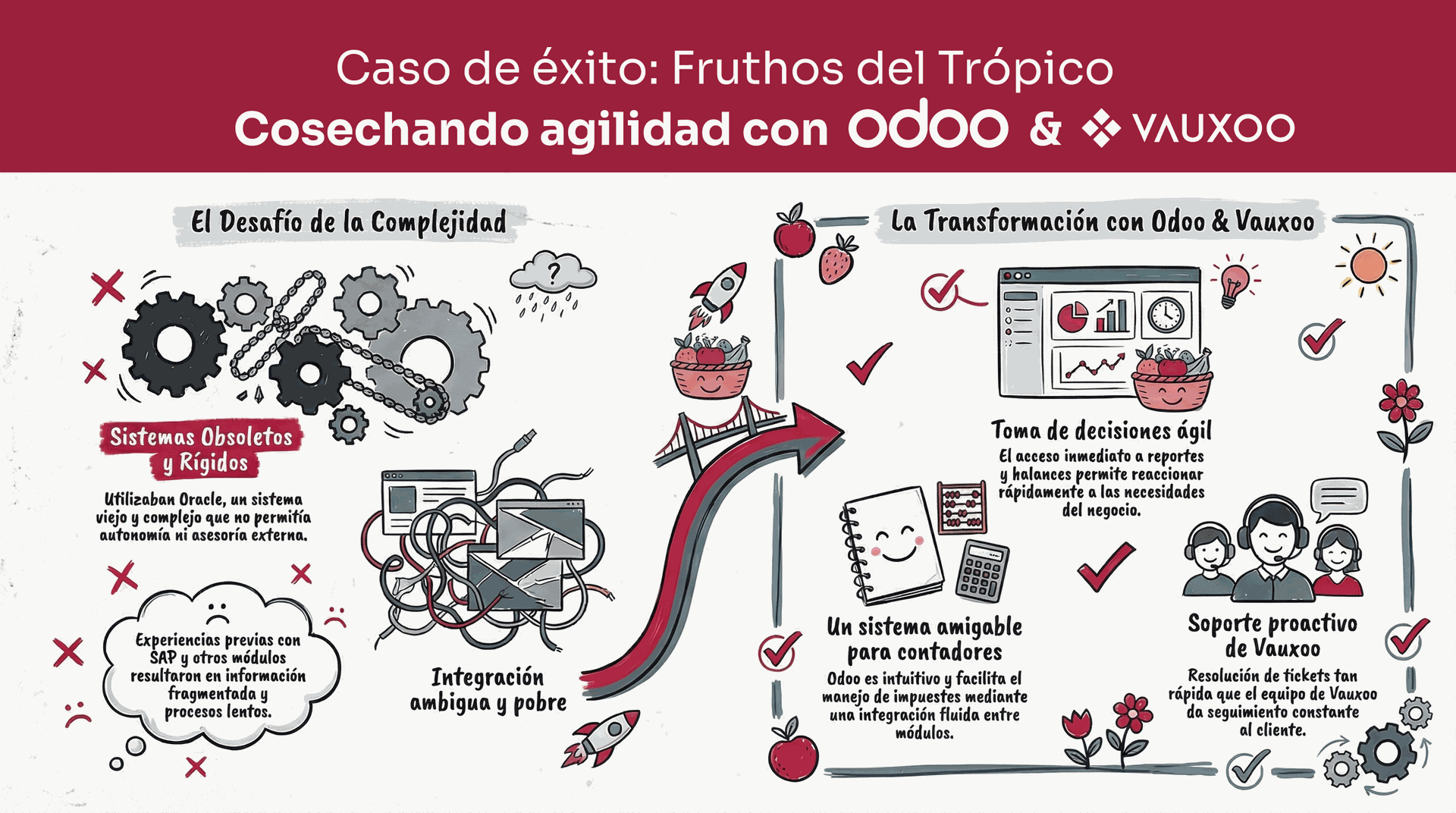
Before implementing Odoo, the company operated with traditional systems that generated friction in their daily operations.
Their experience with tools like Oracle and other structured systems left clear lessons:
- Complex and inflexible processes
- Limited integration between departments
- Fragmented information
- Slow report generation
In a seasonal fruit business, where prices, availability, and demand constantly change, this represented a real risk.
From Oracle chaos to Odoo agility: How Fruthos del Trópico revolutionized its management
A decade ago, Fruthos del Trópico — a family corporation with more than 30 years of experience in the tropical fruit market — made a decision that would shape its future: to become independent from its parent group and consolidate its own business vision. With this transition came a critical challenge. The Oracle system they used had become a “black hole” of technical debt; a tool built “by us for us” that lacked external support and whose rigidity prevented business evolution.
For a company with collection centers, its own crops, and presence across national markets, maintaining a closed system was not just a technical inconvenience, but a latent operational risk.
The power of data: The difference between profitability and physical loss
In the perishable goods industry, information is not just power — it is survival. A 24-hour delay in data flow does not just affect a report; it can translate into physical inventory loss and failed exports. Fruthos del Trópico understood that to scale, they needed total and immediate visibility.
In the perishable goods industry, information is not just power — it is survival. A 24-hour delay in data flow does not just affect a report; it can translate into physical inventory loss and failed exports. Fruthos del Trópico understood that to scale, they needed total and immediate visibility.
Breaking free from traditional giants (Oracle, SAP and Exactus)
The company’s trajectory allowed them to compare the promises of large ERP systems with operational reality. Their experience with Oracle, SAP, and Exactus made one thing clear: “old and overstructured” systems often create operational friction due to their complexity and poor modular integration.
Faced with these closed systems, Fruthos del Trópico chose an open ecosystem. The transition to Odoo represented moving from a suffocating structure to an intuitive platform. This scalability allowed the company to implement processes “their way,” eliminating dependence on opaque internal developments and regaining autonomy to make fast changes without risking system stability.
Total integration: Accounting and compliance “without fear”
For the financial area, the transition was a strategic relief. In other systems, accounting information often feels fragmented, making balance generation slow and error-prone. Odoo transformed this reality by allowing information to “flow from one side to another” efficiently.
For accountants and compliance teams, the platform became a key ally thanks to its ability to:
- Generate real-time accounting with easy-to-manage data layers.
- Simplify tax management through a coherent modular design.
- Eliminate uncertainty, allowing teams to work “without fear” thanks to system transparency.
Vauxoo: Proactivity that goes beyond response capacity
A world-class software is useless without human support that understands the urgency of the business.
In projects like this, something becomes clear very quickly: software alone does not transform a company. The real difference lies in the partnership.
In Fruthos del Trópico’s case, we understood from the beginning that this was not just about implementing an ERP, but about responding to a business that operates under constant pressure, where every decision directly impacts profitability.
That is why our approach was not reactive, but proactive.
Through a close working model, continuous follow-up, and an agile ticketing system, we achieved something that makes a real difference for many teams: Ensuring that support does not become a bottleneck.
In practice, this means that many times our team is the one following up, anticipating needs, or waiting for validations to move forward, ensuring that operations never stop..
Beyond technical speed, what is built is something even more important: Operational trust.
The return of business agility
Fruthos del Trópico’s transformation shows that successful digital transformation is not about adopting the most complex system, but the most agile one. By leaving behind the rigidity of Oracle and SAP for the flexibility of Odoo, the company not only modernized its processes, but also regained the ability to make decisions and act in real time.
Today, operational control is back in the hands of those who truly understand the business. Given this scenario, one key question arises: Are your current tools driving your growth, or have they become technological anchors limiting your ability to respond to the market? Fruthos del Trópico’s case proves that moving toward agility is the most valuable investment for the future.
Want to learn more about their story?
Watch the full case here👇
If your company faces similar challenges — lack of integration, delayed information, or complex processes — at Vauxoo we can help.